|
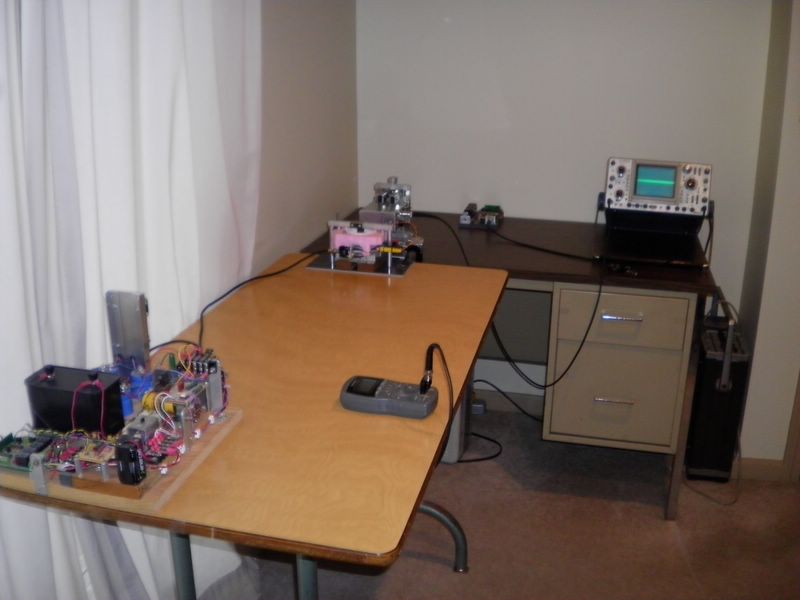
Revised experimental set-up on 28 March, 2016. Front row, left to right: High voltage source, X-Y positioning system for accelerometer module, auxiliary Trigger Board to control oscilloscope sweep (allows isolation of acoustic signals based on assumption that the anomalous signal propagates at light speed). Back row, new 1 Ghz sampling rate, 70 Mhz bandwidth oscilloscope and cryostat. |
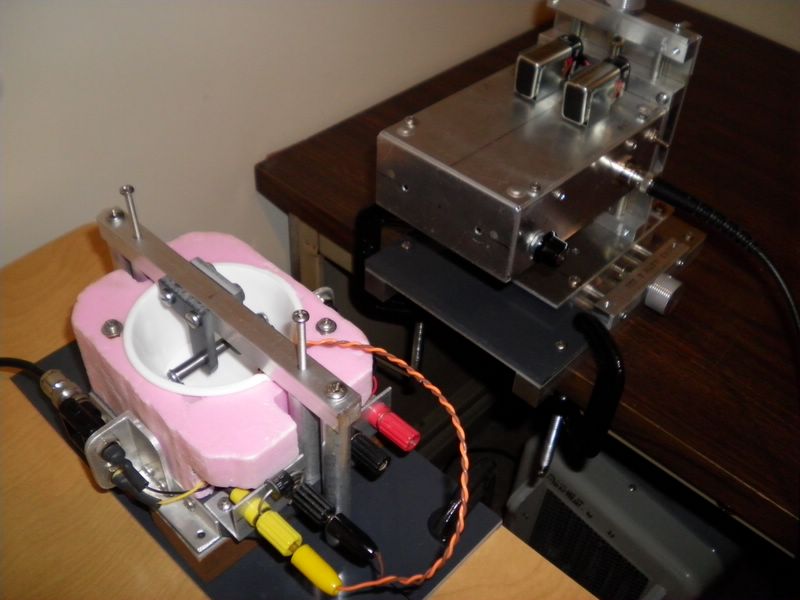
26 April 2016 Set-up For LN2 Test and Custom-Built Positioning System
 |  |
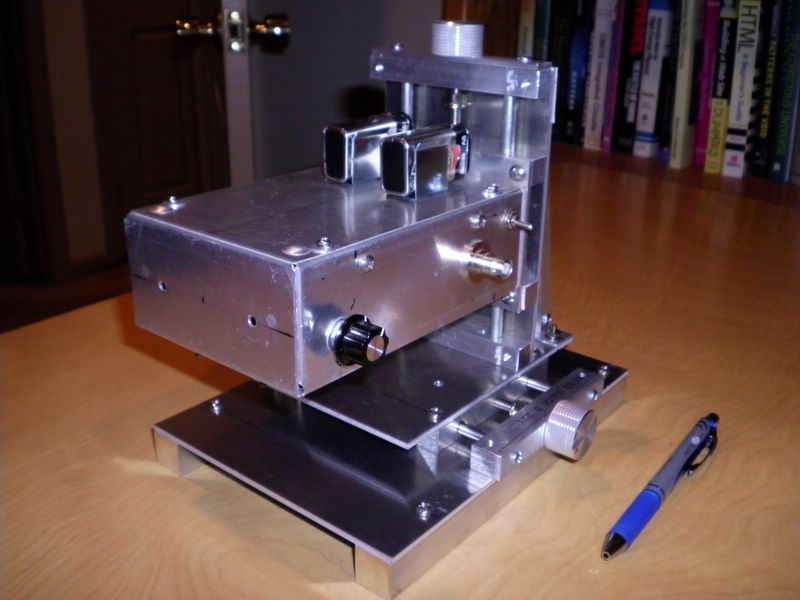 | 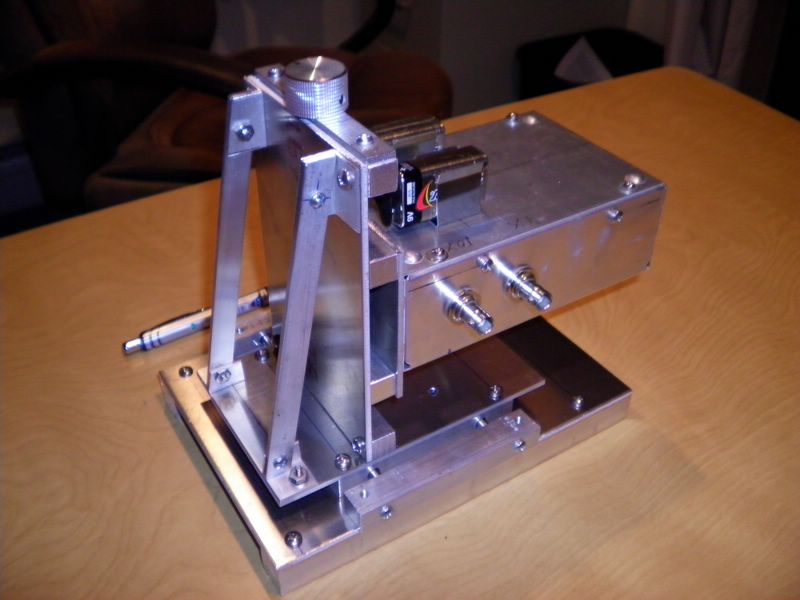 |
OverviewSince 1992 acceleration effects, in the vicinity of superconductors, or superfluids, tens of magnitudes larger than General Relativity allows, have been claimed. By far, the most convincing of these reports has come from the Austrian Research Center (ARC) (Tajmar et al, 2003-2007). It's speculated these signals constitute a tiny residual of a gravity-emulating force, 40 magnitudes stronger than its classical counterpart. A supersymmetric quanta, that ranges to 10-19 m. (TeV scale), is the proposed source of this field. Such a quanta might arise naturally at the boundary of a parallel 3+1 negative-energy space and our 3+1 positive-energy braneworld. Effectively such quanta would possess zero net energy, and thus not violate energy conservation. Their inherent field structure would imprint an Alcubierre topology on spacetime. The resulting geodesic hypersurfaces would neutralize angular acceleration forces on electrons and nucleii that can reach 1022 g's, or more, in the hydrogen atom. This would explain the absense of synchroton radiation, and consequent stability of atomic structures, at a more fundamental level than the Quantum Mechanical requirement for integer wavelength orbits. Vacuum polarization, from this field, is speculated to momentarily evolve massless spin-2 gravitons, of both the negative-energy and positive-energy variety, in response to acceleration, until equilibrium is restored. Macroscopic coherence in superconductors, would raise these, exceedingly brief, graviton 'bursts' to detectable levels. The burst of negative-energy gravitons, directed opposite to the condensates acceleration, is speculated to create the momentary repulsive force seen in these superconductor experiments. It is further speculated that a continuous inflow of negative-energy gravitons across our Universe's brane boundary, from the negative-energy brane, is the cause of cosmological inflation. In short, a common denominator may underlie atomic stablity at the smallest scales, cosmic inflation at the largest scales, and anomalous phenomena seen in superconductor experiments. If these speculations are valid, the Alcubierre Warp, in microscopic form, would be ubiquitous in nature. While the concept of "gravity shielding" has long been discounted on theoretical grounds (incompatible with General Relativity), creation of transitory acceleration pulses via quantum processes may explain any genuine signal that was observed. Based on a theoretical idea (A Physical Interpretation of Matter Waves), only acceleration of the bulk superconductor, supercurrent, or superfluid will produce an acceleration signal, and then only for the duration of the acceleration. Thus the experiments have, to some degree, replicated Podkletnov's "Impulse Gravity Generator", which would indeed have sharply accelerated the supercurrent. For the record, in a series of experimental runs in late March, 2010, apparent acceleration pulses were detected with a PM-3214 oscilloscope. The scope was triggered by the accelerometer's output, every time a 40 mfd capacitor, (charged to 300 volts), was discharged through the superconductor. Control runs seemed to rule out electromagnetic pulses (EMPs) as the culprit, but more runs are needed under identical conditions. The new set-up, pictured above, has most of the experimental components secured to an 11 by 11 by 3/4 inch oak platform. The control box, with cable leading to the high voltage circuit, has been replaced by a 433 MHz RF link, that allows charging and discharing of the capacitor bank remotely. The small remote, on a keychain, is visible on the right side of the photo. This eliminates the danger of having nearly 1000 volts accidentally reaching the hand-held control box. The aluminum project box, in the foreground, houses the accelerometer and associated circuitry. To its left is the cryostat with slidable fiberglass tabs supporting the anode and superconductor. A kit LCD voltmeter has been mounted on a vertical metal frame for monitoring the charging voltage. Only two of the four relays are used; one for starting and stopping capacitor charging, the other to trigger discharge through the superconductor load. An ADXL203, plus/minus 1.7g accelerometer chip (resolution 1 milli-g), aligned with the supercurrent axis, monitors for signal. It is enclosed in a 2" by 4" by 6" aluminum project box for RF (radio frequency) isolation. The accelerometer's output is first referenced to analog common in a 5 volt, bi-polar supply; established by 7805 and 7905 regulators, that, in turn, are fed by a pair of 9 volt batteries mounted outside the case. The second op-amp on the 747 chip provides a 10-to-1 signal gain. Shielded coax cables both within the box to through-panel BNC connectors, and from the box to the oscilloscope adds further RF isolation. Signals can be tapped either directly from the ADXL203's output, from the referencing stage, or the final amplifier output. Using a solid state accelerometer overcomes a pitfall in previous attempts to measure acceleration phenomena from superconductors with a digital scale and target mass. Any brief acceleration pulse would have been averaged over the sampling interval of the digital scale, and further diluted by the large inertial mass of the target. Moreover, negative results would be expected for a static superconductor, in which the bose-condensate is not being accelerated, if the theory presented here is correct. Back in 2010, electric discharge directly through the superconductor was the sole method tried, and hasn't been attempted since. The YBCO superconductor, which yielded signals by this method, was accidentally ruined when silver epoxy was applied to both sides of it, in an effort to obtain electrical contact over its entire surface. Therefore a coil was wound on a fiberglass cylinder slightly larger than the superconductor. Discharging the capacitor through this coil induces a circulating supercurrent in the the tangential plane of the superconductor. The induction method was tried in late May of 2010, with interesting results. In the superconductive state the PM-3214 scope was triggered, by the accelerometer's output, in multiple runs when the 40 mfd capacitor was discharged through the solenoid. Scope triggering was not observed after the YBCO chip transitioned into its non-superconducting state. Tried various combinations to duplicate triggering, but only 300-350 volts discharge from 40 mfd capacitor, with YBCO chip in superconductive state, produced results in 3 runs. While tantalizing, since the triggering was close to the noise threshold of the system, it's not irrefutable proof of anamalous phenomena. Tests with a non-superconducting aluminum blank were carried out in early June, 2010, and did not duplicate the triggering effect seen with the YBCO chip in the superconductive state. Matter Waves, Superconductor Anomalies and Dark Energy De Broglie (matter) waves underlie all of chemistry and even biology at the molecular scale. What matter waves do has long been elucidated through the de Broglie and Schrödinger equations, and Born's statistical interpretation, but what they actually are, or consist of, remains an unanswered question. As every freshman college physics student learns matter waves are intimately linked to nature's fundamental unit of action - Planck's Constant - through the relation: λ = h/p, where λ is the wavelength associated with a particle, p is the particles momentum, and h is Planck's constant. DeBroglie showed that for stable orbits to exist the relation: nλ = 2πR, where n is an integer and R the radius of the orbit, must be satisfied. Erwin Schrödinger was once of the opinion that matter waves represented a real disturbance in space, analogous to the field variables in electromagnetic waves Implicit in a length-time analogue of the electromagnetic field is a bi-polar length variable that contracts/expands and a bi-polar time variable that retards/advances. By definition, one half of such a wave cycle, in which length expands and time advances, corresponds to a negative energy state of the vacuum (a positive mass planet contracts length scales, and retards clocks, a negative mass planet will have the opposite effect). The combined effect of these two variables is proposed to be the origin of the imaginary phase factor 'i' in Schrödinger's wave equation: iħψ = Hψ, as well as in Heisenberg's commutative relation: pq - qp = ih/2π. It is speculated that these bi-polar length and time variables account for all quantum interference phenomena, for which the phase factor i is known to be the source. In accordance with Maxwell's laws, a changing 'length current' should give rise to a changing 'time current' and visa-versa. The amplitudes of these two variables would cyclically rise and fall, in step, as the length-time wave propagates past an observer. Clearly, an observer (particle) entrained at a crossover point of a length-time wave (where the wave transitions from a positive to negative vacuum condition) would be continually preceded, within 1/2 wavelength, by a region of contracting spacetime, and trailed within 1/2 wavelength by expanding spacetime (incidentally, this "crossover" point corresponds to the boundary between a higher dimensional "bulk" space, and our 3+1 brane. String theory proscribes that all open-ended particles exist at this boundary - see below). Such a local distortion of spacetime is the metric signature of an Alcubierre warp But, such a gravity-emulating, Maxwell gauge field cannot be massless, otherwise it would have long since been detected. If it exists at all, it must be in the unexplored supersymmetry realm between 1 and 100 TeV. The warp field of a length-time 'photon' would, accordingly, take the form of a micro-warp in the 10 Large amplitude expansions/contractions of spacetime within the micro-warp's operational radius, stemming from di-pole gravity 40 magnitudes greater than Newtonian gravity, must lead to correspondingly large synchronization (sync) shifts. Since this micro-warp concept is based on extra dimensions of space, a logical deduction is that during the contraction cycle the volume of space within the warp 'bubble' shrinks to the size of the extra dimension(s) and expands into them. Having the higher dimensional bulk serve as the source and sink of spacetime (gravitons) for these alternating expansions and contractions would obviate the need for negative matter to implement an Alcubierre warp. From 2003 to 2007, a group of researchers, led by Martin Tajmar, at the Austrian Research Center, detected anomalously large (up to 277 micro-gs) acceleration signals from a rapidly spun-up, ring shaped, niobium superconductor. They interpreted this acceleration signal (which opposed the applied acceleration) to be a gravitoelectric field, induced by a time-varying gravitomagnetic field. When they attempted to detect the gravitomagnetic field directly with sensitive gyroscopes, they found only 1% of the signal they were expecting. Furthermore, this supposed gravitomagnetic field did not follow the inverse square rule as was expected. Since only an acceleration field was detected, an alternative explanation is proposed. Cooper pairs move as a supercurrent through the lattice, progressively bonding from one lattice site to another as they advance. If the acceleration nulling, dipole field really exists, then all cooper pairs, and their proton (lattice) partners, would experience zero-g acceleration within the 10-19 meters frame of theis field, for all components of momentum. Effectively, perfect superconduction would correspond to an acceleration-free dance for both the moving cooper-pairs, and the flexing lattice sites, as this field exactly cancels the acceleration components apparent to external observers. When the experimenters applied an acceleration to the body of the superconductor, this perfect balance was briefly upset. Since this hypothetical length-time (LT) field is a guage field, like long range electromagnetism, it would respond, like that field by trying to 'brake' the applied acceleration. The problem is that the LT field ranges only to 10-19 meters, so its long range detection is an issue. The proposed explanation is that the LT field, associated with each electron and proton, functions as a micro-pump for shuttling massless gravitions between the extra dimensional bulk and our 3-brane. Assuming fundamental particles are fixed to the brane ' wall' separating our 3D space and the extra dimensions, and enveloped by virtual micro-warps, each particle would see every other particle cyclically receding and advancing in position relative to every other particle. The resulting sync shifts would induce forward/backward translations in time - each particle seeing every other particle oscillating between the past and future, but averaging to the local present. Such temporal oscillations could underlie the weird, non-classical aspects of quantum mechanics as illustrated in John Cramer's Transactional Hypothesis. The electromagnetic-gravity duality, implied in a length-time Maxwell field's existence, is postulated to be embraced within one of six dualities betweeen the forces comprising the superforce. Three forces comprise the superforce above the electroweak synthesis - strong force, electroweak force, and gravity, which would converge in strength, in the TeV scale, if non-compact extra dimensions were indeed a reality. This yields six dualities by the permutation rule N!, where N=3. These six dualities are proposed to correspond to the five 10D string theories and 11D supergravity that make up the tableau of M-Theory. Each of these field theories is speculated to reside on its own m+n "brane" in the 5D "bulk"., where m and n are integers denoting the number of space and time dimensions, respectively. It's also intriguing that the most recent measurements of dark matter by a Cambridge University team shows that 'dark matter' composes between 80-85% of the matter of the universe. It has been suggested that dark matter is really matter sequestered on nearby branes in the higher dimensional bulk. If our brane is but one of six, and all branes are about equal in extent (in terms of total mass energy), then 5/6ths (83.3%) of the matter of the 'multiverse' would be hidden background matter on the other 5 branes; right smack in the middle of the Cambridge team's estimate. Finally, this Maxwell length-time field would be massless on a "3-brane", whose 'spacetime' has electric and magnetic parameters. Such a 3+1 (3 electric/1 magnetic) brane would constitute an S-dual version of our 3+1 (3 length/1 time) brane universe. Conversely, our photon would underlie matter waves in their universe, since it would have a TeV range mass, and exhibit their form of gravity in a dipole form, but range to less than 10-19 meters. .
The Multifamily Structure of MatterSupersymmetry with a Triplet Higgs
|
Copyright 1998, David Sears Schroeder |